
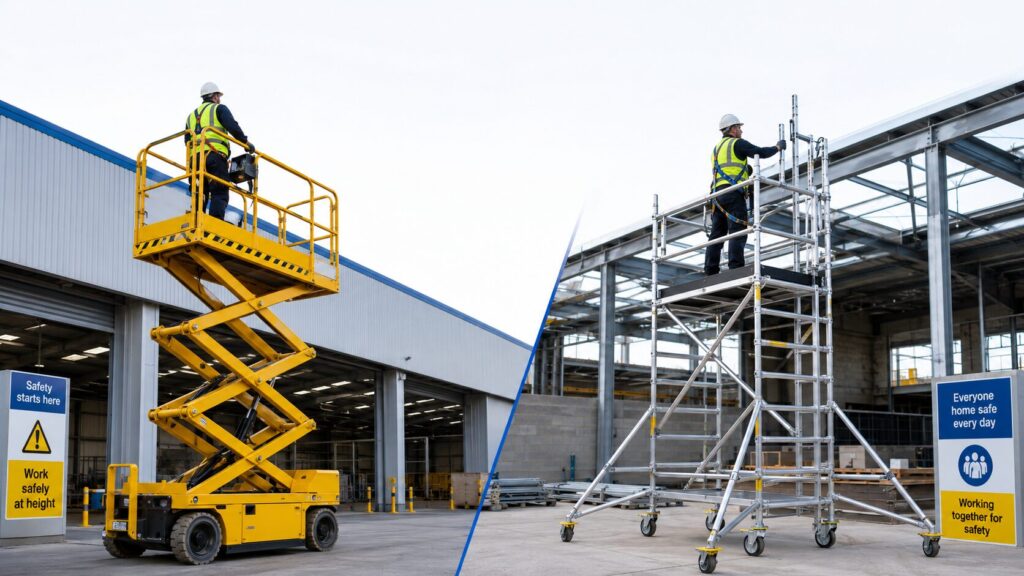
Working safely at height is a legal requirement and an essential part of protecting employees, contractors and members of the public. However, one of the most common questions we hear is:
“Do I need IPAF training or PASMA training?”
Although both qualifications are designed to improve safety when working at height, they cover completely different types of equipment and are intended for different job roles.
In this guide, we’ll explain the differences between IPAF and PASMA training, who each course is designed for, and how to choose the right qualification for your business.
IPAF (International Powered Access Federation) training is designed for people who operate Mobile Elevating Work Platforms (MEWPs).
These include:
The purpose of IPAF training is to teach operators how to safely inspect, operate and manoeuvre powered access equipment while complying with current health and safety legislation.
Successful delegates receive the internationally recognised IPAF PAL Card, demonstrating they have completed accredited operator training.
PASMA (Prefabricated Access Suppliers’ and Manufacturers’ Association) training focuses on the safe assembly, inspection, dismantling and use of mobile access towers.
Unlike IPAF equipment, PASMA towers are not powered. They are manually assembled and moved into position before being used as a working platform.
Delegates learn how to:
Successful candidates receive a PASMA certificate and PhotoCard, recognised throughout the construction and maintenance industries.
| IPAF Training | PASMA Training |
|---|---|
| Covers powered access equipment (MEWPs) | Covers mobile access towers |
| Learn to operate scissor lifts and boom lifts | Learn to assemble and dismantle towers safely |
| Equipment is mechanically powered | Equipment is manually erected |
| Includes practical operation of machinery | Includes practical tower assembly |
| Awarded with an IPAF PAL Card | Awarded with a PASMA Certificate and PhotoCard |
Although both qualifications involve working at height, they are not interchangeable.
If your job requires operating a cherry picker or scissor lift, you’ll need IPAF training.
If you’re assembling or using a mobile scaffold tower, PASMA training is the appropriate qualification.
Absolutely.
Many professionals benefit from completing both IPAF and PASMA training because different projects require different access equipment.
For example, a maintenance engineer may use:
Holding both qualifications gives employers greater flexibility while improving workplace safety and compliance.
Both qualifications are widely recognised across the UK and are commonly required in sectors including:
Many contractors now require evidence of accredited working at height training before allowing operatives on site.
Choosing an accredited training provider ensures delegates receive training that meets recognised industry standards.
Accredited courses provide:
Proper training not only helps protect employees but also demonstrates an employer’s commitment to maintaining high health and safety standards.
At Harris Safety Training Services, we are proud to deliver accredited IPAF and PASMA training for businesses and individuals across the UK.
Whether you’re looking to certify a single operator or train an entire workforce, our experienced instructors provide professional, practical training that helps delegates work confidently and safely at height.
We offer:
Our aim is simple: to provide high-quality safety training that helps employers remain compliant while giving delegates the skills they need to work safely and efficiently.
The choice depends entirely on the equipment you’ll be using.
Choose IPAF Training if you will be operating:
Choose PASMA Training if you will be:
If your role involves both types of equipment, completing both qualifications will provide the broadest level of competence and flexibility.
Whether you’re an employer looking to upskill your workforce or an individual seeking industry-recognised qualifications, Harris Safety Training Services can help.
Our accredited IPAF and PASMA courses are delivered by experienced instructors at training centres across the UK or at your own premises, helping you stay compliant, improve safety, and work confidently at height.

