
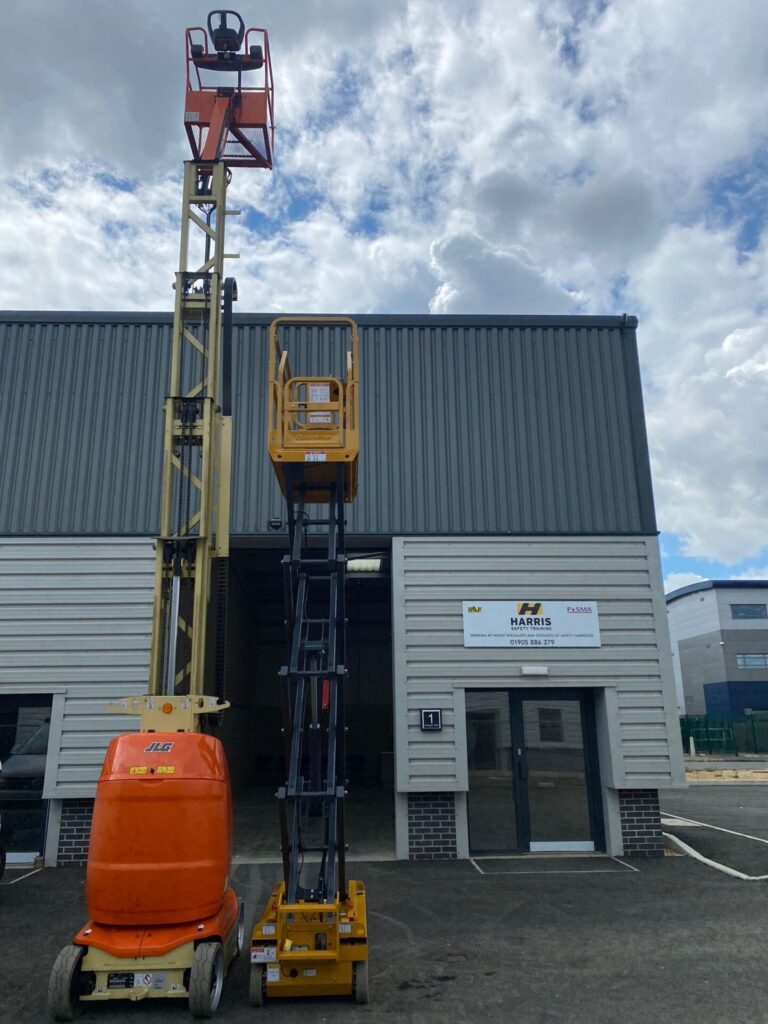
Looking for IPAF training near Nottingham or Lincoln? Harris Safety Training Services welcomes individuals and teams from both areas to our indoor training centre in Newark, Nottinghamshire. You can book MEWP operator training for scissor lifts, mobile booms and static booms, with the choice of classroom or online theory on selected dates. Which course to book depends on the machine you’ll use and the categories your work requires.
Ready to book? See upcoming IPAF dates and prices and choose an event marked Newark Venue. If you’re still waiting for the hire company to confirm the machine, or you need to book several people, ask our training team before reserving places.
A mobile elevating work platform, or MEWP, is a machine that raises people to a working position. The word “cherry picker” is often used for several different types of boom. It can describe a self-propelled machine, a trailer-mounted platform or a compact machine that works from stabilisers. For booking purposes, the machine’s make, model and category are more useful than its nickname. Ask the hire company or whoever is providing the equipment to confirm those details in writing.
IPAF category 3a covers mobile vertical platforms, including many scissor lifts and mobile vertical personnel platforms. They generally raise the platform vertically. This category may be relevant if you’re changing fittings above a warehouse aisle or installing services below a ceiling and the chosen machine is a mobile vertical platform. Confirm the model even if the equipment list just says “scissor lift”. A category identifies the type of machine covered by your training. Selecting a specific model for the job still depends on the working height, load, access route, floor conditions and other site constraints.
IPAF category 3b covers self-propelled boom lifts. You might encounter an articulated boom where the platform has to reach around an obstruction, or a telescopic boom where the task calls for outreach. If a hire quote says “boom lift”, confirm whether it is a self-propelled mobile boom or a machine that operates as a static boom. For a maintenance team that uses both mobile vertical lifts inside a building and self-propelled booms outside, 3a and 3b are the two categories to discuss.
IPAF category 1b covers static booms that work from a fixed position when elevated. Examples include vehicle-mounted platforms, trailer-mounted booms and certain spider-type machines that deploy outriggers. A machine can travel to its set-up position and still fall into the static boom category. If you’ve only been told the machine is a “spider” or that it arrives on a trailer, ask for the exact model before booking. IPAF lists the categories and examples in its official machine category guide.
If you only operate one type of machine, ask whether a single category matches that work. If your job involves two types, make sure both categories appear in the booking. For example, a shopfitting team might use mobile vertical lifts for internal work and a self-propelled boom for an external sign installation. Someone who will operate both needs to establish the requirements for both machines. A colleague working with a mobile vertical lift only may need a different booking.
For teams using a mix of machines, building a simple delegate list saves time. Put each delegate’s name next to their actual machine types, then add the categories already shown on their current card and the expiry date, where applicable. Include anyone who needs to train before a specific contract starts. This gives the training team enough information to suggest suitable sessions and makes it easier to keep staff on site while others attend.
Start with the role too. There’s a difference between an operator who drives the MEWP, someone who supervises the work and someone nominated for ground rescue. On a small site, one person may have more than one responsibility. Tell us which activities the course needs to support so we can explain the available training routes. If your team is deciding how to manage a MEWP operation, HSE’s guidance on MEWP selection, planning and competence covers the wider responsibilities, including planning for rescue and having someone on the ground who can act in an emergency.
The IPAF MEWP Operator course combines a theory section and test with practical training and assessment. The right delivery route depends on how the delegate learns, when they can complete the theory, and whether the chosen combination is available on their preferred date. Check the event details before paying, particularly if a manager is booking for someone else. IPAF explains the course structure and assessment in its MEWP Operator Training overview.
Classroom theory gives delegates scheduled time with the instructor for the theory element. It is worth considering if you prefer questions and discussion as you go, or if it’s easier to protect a block of work time than to arrange online study. Ask for the arrival time, expected finish and categories covered by the session when planning transport or shifts.
eLearning theory lets you complete the online learning before coming to the centre. Set aside time to work through it and read the joining instructions as soon as they arrive. You still attend in person for the practical training and assessment. Check the booking and joining instructions for the arrangements for the theory test, including when it takes place. If an employer books the place, the delegate should receive the access details and know who to contact if the course does not open or a joining email goes missing. Explore Harris Safety’s IPAF eLearning route.
If a delegate would benefit from language, reading or other learning support, contact us before choosing a date. Explain what has helped in previous training and ask what can be arranged for this course and its assessments. That leaves time to confirm the details before transport, work cover and course places are arranged.
Our Newark training centre is at Unit 1, Jessop Park, Jessop Close, Newark, Nottinghamshire, NG24 2UD. Customers travelling from Nottingham and Lincoln attend training at this address when their event is marked Newark Venue. The IPAF calendar also lists events at other venues, so check the venue on the event and in your confirmation, particularly if someone else made your booking. Find the Newark address and map on Locations & Contact.
Read the joining instructions before the course date. They tell you where and when to report, what identification or equipment to bring, and any preparations for your specific session. If you’re booking for a coworker, forward the confirmation and ask them to check the practical details themselves. If anything about PPE, arrival or access is unclear, ask the centre before setting out. A delegated booking works best when the person attending can read the original instructions and contact us directly if a question comes up.
If you’re working to a project start date, allow time for the theory and the practical session, and check what training record the employer or site needs. Before you send staff back to the task, arrange familiarisation with the actual make and model they’ll use. The course covers a machine category and the workplace still needs to plan the job, supervise it where required and arrange a suitable rescue procedure. Read HSE’s guidance on selecting and managing MEWPs.
If several operators are due for renewal or you have a new team starting, share the delegate numbers, machine categories, preferred dates and any deadlines when you enquire. One common example is a facilities contractor with four scissor lift operators and two colleagues who also work from a boom. A list of those two requirements is more useful than a request for six identical places. It allows the training team to discuss suitable session options and gives you an accurate basis for comparing the total cost and the time people will need away from work.
If the team cannot leave site together, ask about splitting the booking across dates. Where you’re considering training at your own premises, tell us which machines would be available and give us an overview of the site and the space for training. The training team can discuss suitability with you. For personal bookings, have the machine category and your preferred delivery route to hand. If your project or hiring arrangement is still being finalised, you can discuss the category with us while you wait for the machine details.
When comparing dates or prices, write down the Newark venue, the categories included, the theory route, how many places you need and the time delegates should allow. Then check the booking for anything you need to arrange separately. Two listings can appear similar at first glance even when they cover different categories or use different theory formats. If you’re working from a quotation, ask which extras apply to your team and whether the quoted total includes VAT. That makes it easier to compare the full booking cost against the time away from work.
For example, a Lincoln contractor may need to train two new recruits on scissor lifts while renewing a colleague who uses both scissor lifts and mobile booms. Sending the same purchase order description for all three can hide the difference. List the equipment and categories against each person, mark the renewal separately and ask which combinations are available on the dates you can release them. If a hire contract is still being negotiated, ask for the proposed machine details before confirming the operator places.
After training, check the categories and expiry dates against your training records and the work you’ve assigned. Keep a separate record of familiarisation for the equipment on site. This makes it easier for a supervisor to check both pieces of information when a machine is replaced or someone covers another shift. If a hire company supplies a different make or model at short notice, tell the person responsible for planning the work so they can review the arrangements before it starts.
Yes. IPAF describes its MEWP Operator course as suitable for beginners. Let us know that you are new to powered access and tell us which equipment your employer or customer expects you to use. The course format and duration vary with the machine, categories and experience. If the employer is arranging your place, ask them to share the job and machine details as well as the date.
Some sessions include more than one category. Check the event listing for the combinations offered and agree the exact categories with our team if your requirement is unclear. If you need all three, ask about availability and duration before booking. A listing for two categories will only suit your needs if it includes the two you require and you have a separate arrangement for any remaining category.
Successful IPAF MEWP Operator candidates receive a Powered Access Licence, known as a PAL Card, showing the categories achieved. In the UK the card is issued digitally via IPAF’s ePAL app and is normally valid for five years. Check the actual expiry date shown on the card, especially if you have existing categories or are planning a renewal. IPAF explains card access and verification in its PAL Card guide.
Share your existing categories and expiry date when you contact us. Tell us which equipment you expect to operate over the next few months. IPAF offers a shorter renewal option for eligible operators whose current cards are due to expire. If you need a new category as well, ask what needs to be assessed and how it affects your booking. Starting before expiry gives you time to confirm the training route and find a date that fits around the job.
Open the upcoming IPAF dates and prices page, choose an event marked Newark Venue and read its booking options. Compare the options for the exact categories you need and check what is included before paying. The calendar is the place to see current availability. For group bookings, a date you cannot find in the calendar or a combination you cannot select online, contact the team to discuss what is available.
You can study the theory online when you book an eLearning option. Operator training still includes practical instruction and assessment in person. Read the event and joining details for the format of the theory test and any preparation deadline. If your team books for you, ask for the confirmation early enough to complete the required study before attending.
Have the machine details, preferred dates and number of delegates ready. For the next available places, check the IPAF calendar and choose Newark Venue. If you’re unsure about 3a, 3b or 1b, or you need to coordinate several bookings, call 0330 127 0310 or email info@harrissafetytrainingservices.co.uk. You can also view the full Newark IPAF course range.

