
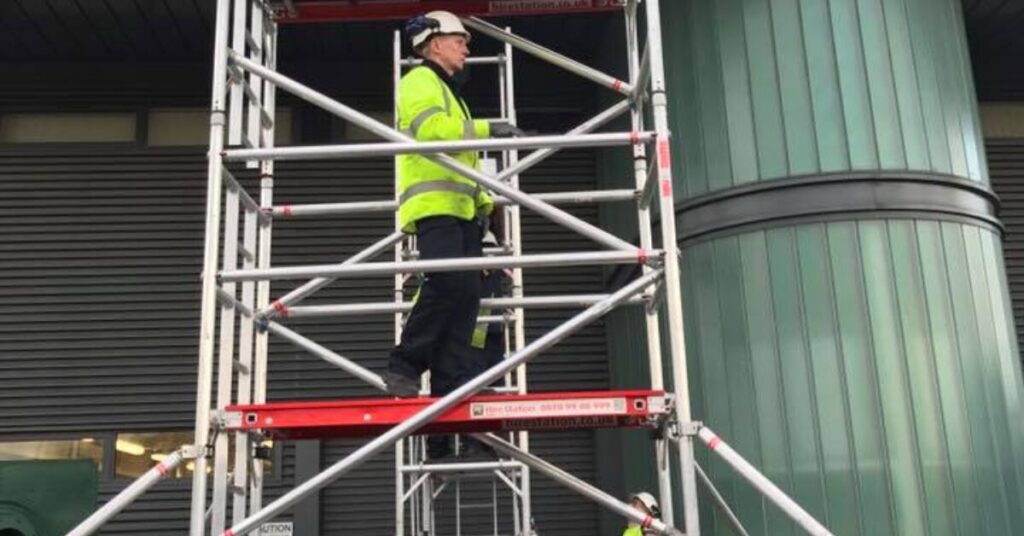
The next light fitting is only a short distance away. That does not make moving a mobile tower an automatic part of the job. A small relocation can introduce a different floor surface, an overhead obstruction or a route through other people's work. Plan the move and the next position before releasing the tower to travel.
Never move a tower with people or materials on it. Follow the manufacturer's moving instructions, including its permitted configuration and any height reduction required. HSE advises reducing tower height to a maximum of four metres for movement, checking the ground and overhead route, and using manual effort from the base. Equipment-specific requirements still need checking.
Look at the whole route rather than just the visible gap ahead. Consider doors, thresholds, surface changes, potholes and overhead hazards. Who will manage nearby pedestrians or vehicles? Is there room at the destination for the required tower configuration? If the route cannot be made suitable, reconsider the access arrangement rather than improvising a way through.
Weather matters too. HSE advises against moving towers in windy conditions, and PASMA highlights the effect of local wind on tower stability. A sheltered starting point does not prove an exposed destination is suitable. Consider the conditions expected during the work, and use the tower instructions and site assessment when deciding whether to proceed.
After movement, review the equipment's condition and the new location before use. PASMA explains that moving a tower does not automatically require a fresh formal inspection, unless significant alteration was needed or something happened that could affect safety. That is different from assuming no checks are needed once the tower stops moving.
For employers, ask whether all staff expected to relocate towers have training relevant to that duty. Someone who only works from a platform may have different learning needs from the person responsible for moving it. Build the relocation arrangements into the work plan so the team can recognise when the next position needs a new decision.
Plan the destination before beginning the first task. If several work positions are needed, identify the route between them and consider whether the tower can be moved within the manufacturer’s permitted arrangement. A proposed shortcut through an occupied area should be assessed before the team reaches it. Knowing the next position also helps the supervisor coordinate other work and prevent pressure to move before the route is ready.
Allocate clear roles for the move and make sure everyone involved understands the stop signal and their responsibilities. The arrangements should account for people nearby as well as those moving the equipment. If a doorway, threshold or surface restriction prevents the planned move, stop and review the method. Do not allow a worker to remain on the tower to save time or use improvised assistance to overcome an unsuitable route.
After relocation, establish that the next position meets the equipment instructions and site plan before anyone climbs. Consider whether significant alteration or an event during movement has triggered the need for a further competent inspection. Keep the distinction between routine checks and formal inspection clear. A move that seemed uneventful still ends with a decision about whether the tower is ready for use in its new surroundings.
For businesses considering PASMA training in Newark, describe movement duties as part of the course enquiry. Tell Harris Safety who assembles, alters, moves and uses the towers, then confirm the appropriate course, venue and date. After training, review the sequence of a representative job with the team. Ask where moves occur, which conditions may change and who authorises a revised method. That practical review turns a general instruction to be careful into a plan people can follow from one work position to the next.
Discuss your team's tower-use and movement duties with Harris Safety when arranging PASMA training.

